Introduction to Fashion Terminology
Ever felt a bit lost in fashion lingo? You’re definitely not alone. Whether you’re sketching your first collection, studying textiles, or building your own brand, the fashion world has a language of its own — and learning to speak it fluently can be a real game changer.
Before I started my own creative business, I taught GCSE Textiles, and one thing I quickly learned was that confidence often begins with understanding the right terminology.
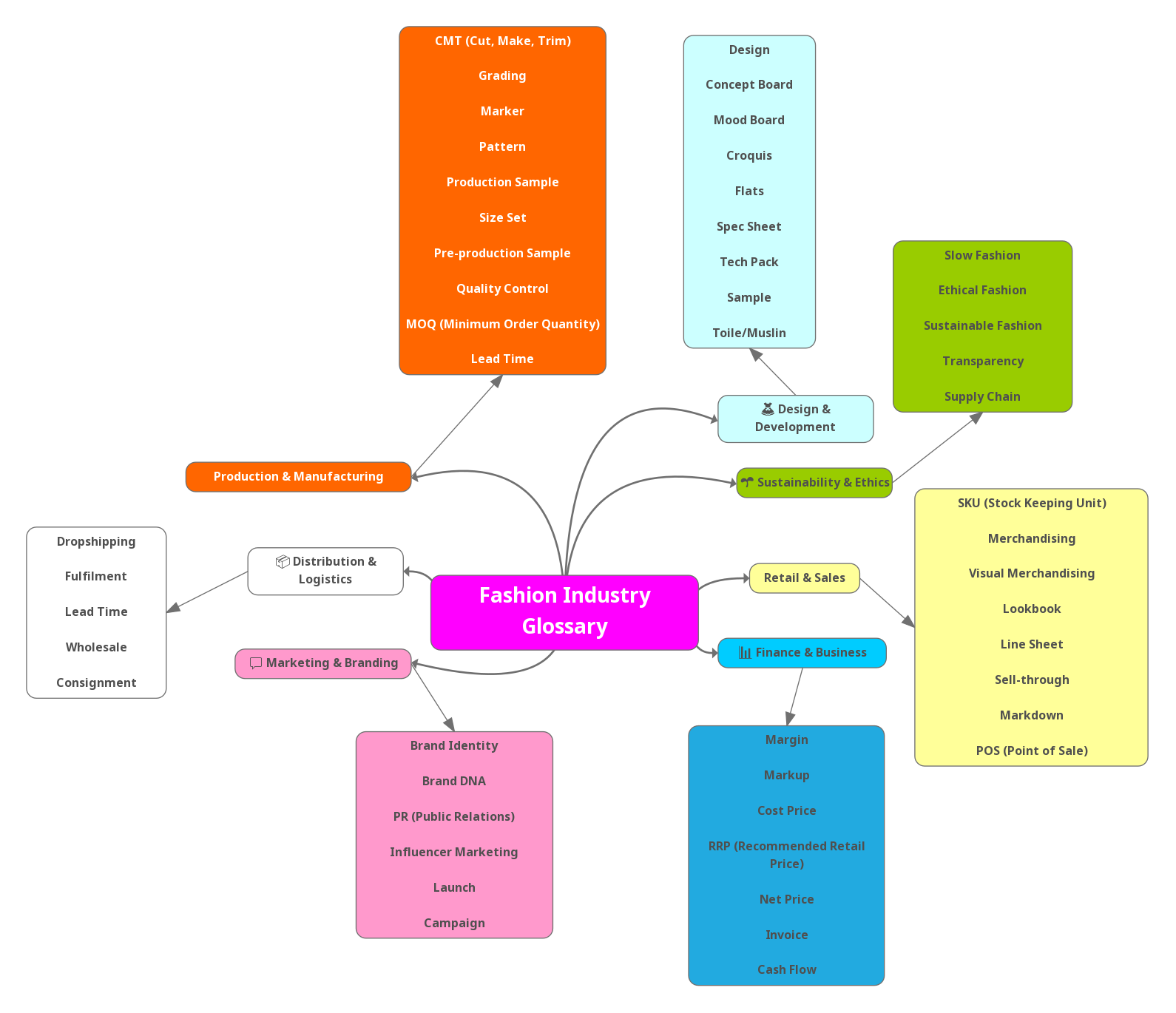
That’s exactly why I’ve created a Fashion Terminology Mind Map — a visual, easy-to-digest guide to all the key concepts across design, production, marketing, and sustainability. Think of it as your creative cheat sheet for the fashion industry.
But it’s not just about memorising jargon (I promise!). It’s about feeling empowered — understanding how each stage of the process connects, from your first sketch to the moment your garment reaches a customer. When you can talk about your work using professional terms, you don’t just sound confident — you are confident.
Fashion Terminology Categories
This mind map breaks down the fundamentals into digestible sections — the kind of stuff I used to teach in class, and still rely on every day in my studio.
👗 Design & Development
🖊 Design
The creative process of planning and sketching clothing or accessories before they’re made.Example: Designers like Stella McCartney and Vivienne Westwood start with sketches and vision boards long before a single fabric is cut. It’s all about turning ideas into something tangible.🖼 Concept Board
A visual presentation of themes and inspiration that shape a collection.Example: Gucci’s Alessandro Michele is known for his eclectic concept boards — mixing vintage photography with modern art to set the tone for his designs.🎨 Mood Board
A collage of images, colours, and fabrics that define the aesthetic of a collection.Example: For a winter range, you might include rich velvets, deep reds, and metallic details to capture a luxurious, frosty vibe.📏 Flats
Technical drawings showing the front and back of a garment, used to communicate details like seams and fastenings.Example: When I taught this in class, I always said flats are your garment’s blueprint — if it’s not on the drawing, it won’t make it into production!📜 Spec Sheet
A detailed document listing all garment measurements and construction details.Example: Think of it as a communication bridge between designer and maker. Even big brands like Zara and Burberry rely on spec sheets to ensure every item is made precisely to plan.
🧵 Production & Manufacturing
🔨 CMT (Cut, Make, Trim)
When a manufacturer handles cutting fabric, assembling garments, and finishing with trims.Example: Many small UK designers use CMT services for bespoke, small-batch production — it’s a practical way to scale while maintaining quality.📏 Grading
Turning one base pattern into multiple sizes while keeping proportions accurate.Example: Brands like Levi’s and Topshop grade patterns to ensure every pair of jeans fits beautifully across sizes. I used to love demonstrating this in class — it’s like maths meets creativity!📅 Lead Time
The total time between placing a production order and receiving the finished garments.Example: Planning lead times is crucial — I learned that lesson quickly when I started producing embroidered sweatshirts. Timing is everything when you’re juggling creativity and customer expectations.
🛍️ Retail & Sales
🔢 SKU (Stock Keeping Unit)
A unique code assigned to each variation of a product (size, colour, style).Example: Every single item at retailers like John Lewis has its own SKU, making stock tracking much easier.🎭 Visual Merchandising
The art of styling retail spaces to attract customers and tell a brand story.Example: Burberry’s window displays are a masterclass — they’re as much a part of the brand’s storytelling as the clothes themselves.📸 Lookbook
A collection of styled photographs showcasing a brand’s latest pieces.Example: Zara and Mango use lookbooks to show how individual pieces can be styled together — something I still find really useful when planning shoots for my own designs.
📦 Distribution & Logistics
🚚 Dropshipping
A business model where products are sold online but shipped directly from the supplier to the customer.Example: Many new fashion businesses use dropshipping to test products before investing in stock — ideal for exploring what sells without big upfront costs.📢 Wholesale
Selling goods in bulk at a discounted rate to retailers who then resell them at full price.Example: Think Nike selling to Sports Direct — wholesale keeps the supply chain flowing and the brand visible.
💬 Marketing & Branding
🎨 Brand Identity
Everything that makes your brand recognisable — your logo, tone, colours, and even your stitching style.Example: For Christian Louboutin, it’s the red soles; for Burberry, the check. For me, it’s thread art — stitched by hand, full of character.📢 Influencer Marketing
Partnering with creators to showcase your work to their audiences.Example: Influencers like Victoria Magrath (InTheFrow) collaborate with brands like ASOS to bridge that gap between product and lifestyle.
🌱 Sustainability & Ethics
🐢 Slow Fashion
A movement focused on mindful, sustainable, and long-lasting design.Example: Stella McCartney and Patagonia lead the way with collections built to last — something I’ve always admired (and teach through my own brand values).🤝 Ethical Fashion
Fashion that ensures fair wages, safe conditions, and responsible sourcing.Example: People Tree has been championing ethical production in the UK for decades — proof that fashion and fairness can coexist beautifully.
📊 Finance & Business
💰 Margin
The difference between what it costs to make something and what you sell it for.Example: If your sweatshirt costs £25 to produce and sells for £65, your margin is £40 — crucial info when pricing your products sustainably.
Why This Matters
This mind map isn’t just for fashion students — it’s for anyone who wants to speak the language of the industry with confidence. Whether you’re a maker, designer, or small business owner, understanding these terms gives you clarity and control over your creative process.
After years of teaching and now running my own brand, I’ve seen how learning the right terminology bridges the gap between creativity and professionalism. It empowers you to communicate your ideas clearly, work effectively with suppliers, and make informed choices in every part of your business.
So, grab a cup of tea, dive into the mind map, and start decoding fashion one term at a time. The more you understand, the more you’ll grow — creatively, professionally, and confidently.